
Industrial Packaging Machinery Slip Rings
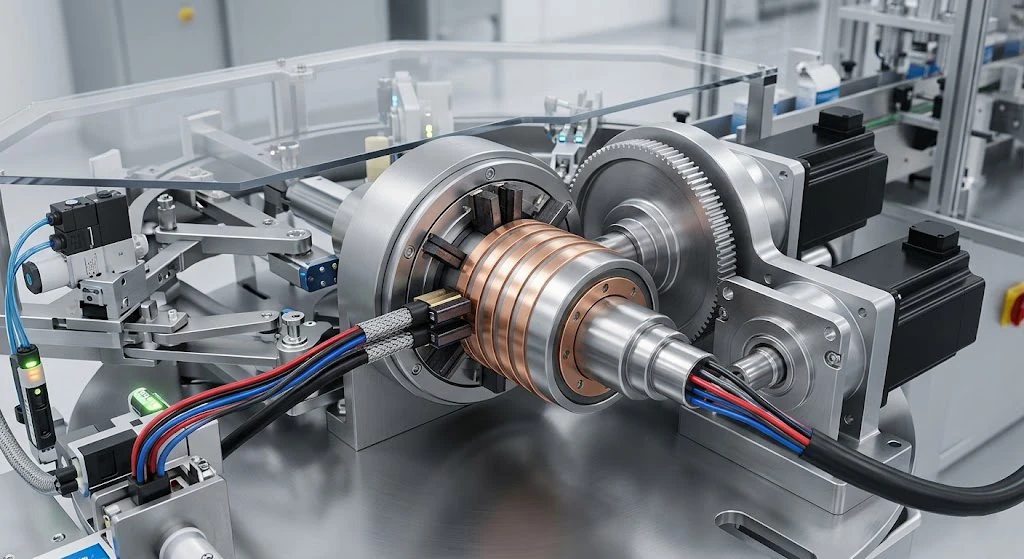
Modern industrial packaging systems rely on high-speed automation and precise synchronization of multiple subsystems. Rotary machines such as filling carousels, capping units, labeling systems, and wrapping equipment require continuous rotation while maintaining uninterrupted transmission of power, control signals, and sensor data. In such architectures, the Slip Ring is a critical component that enables electrical continuity between stationary and rotating parts.
Packaging machines typically operate with servo-driven rotary platforms where multiple stations perform sequential operations under closed-loop control. Each station may include valves, sensors, and actuators that must communicate in real time. Slip rings provide the interface that transfers electrical power, control signals, and feedback data such as pressure, flow rate, position, and torque without cable twisting or mechanical limitations
A slip ring consists of a rotor with conductive rings and a stator with brushes that maintain continuous contact during rotation. Key electrical parameters include current capacity, voltage level, contact resistance stability, and insulation performance. Low contact resistance and minimal electrical noise are essential for maintaining signal integrity, especially in analog measurements and encoder feedback systems
Mechanical design considerations include rotational speed, brush material selection, contact pressure, and wear rate. Improper contact pressure can lead to excessive wear or electrical arcing, reducing system reliability. In addition, packaging environments require high protection ratings, corrosion-resistant materials, and washdown compatibility, particularly in food,textile, agriculture and pharmaceutical applications