
Slip Ring Surveillance Systems | 360° Monitoring
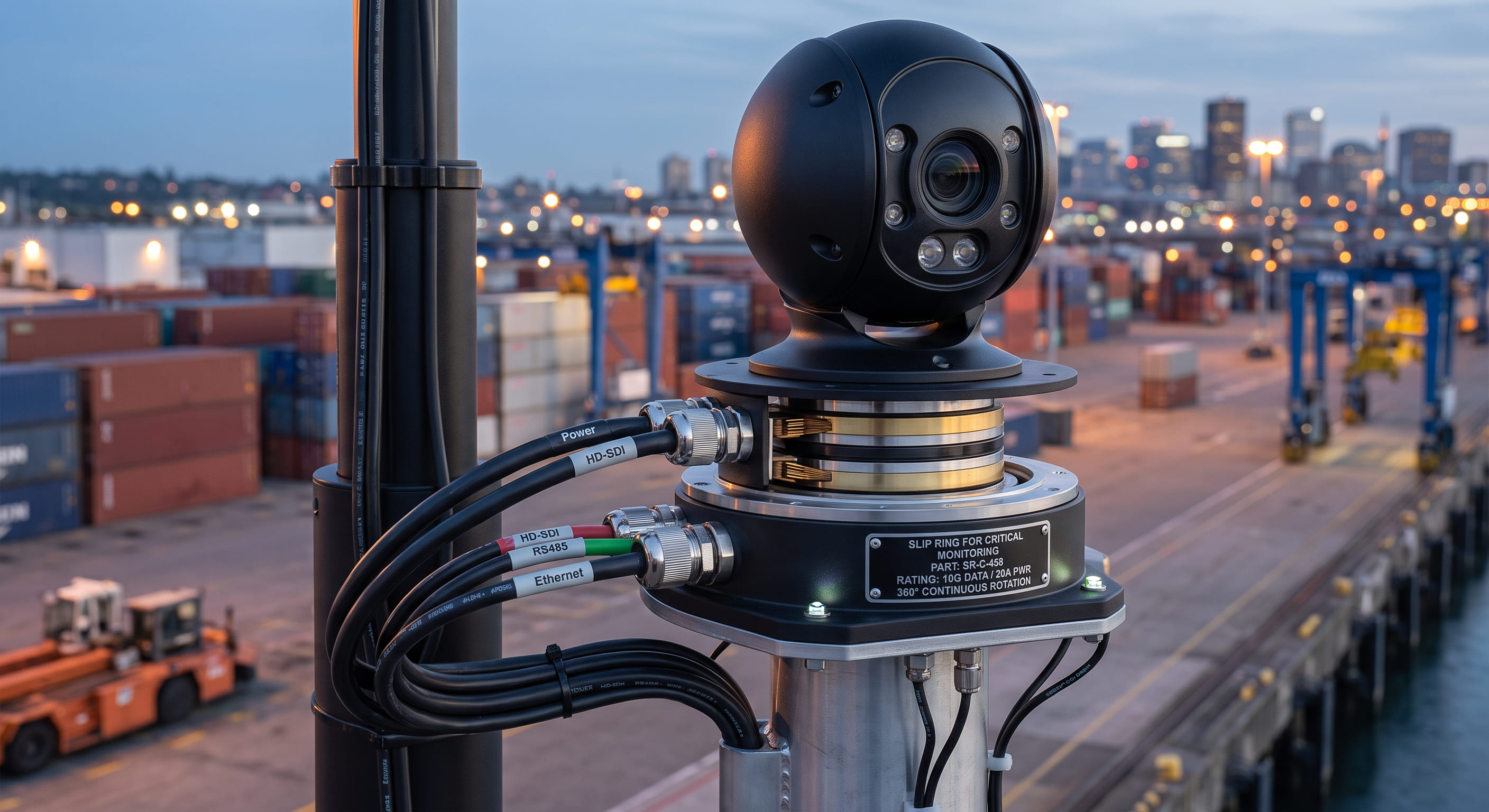
🎥 Slip Ring Applications in Surveillance & Security Systems
Continuous 360° Rotation for Critical Monitoring Environments
Slip Ring Surveillance Systems are essential in today’s security-driven world, where surveillance systems demand uninterrupted operation, precision control, and stable signal transmission. From PTZ (pan-tilt-zoom) cameras in urban areas to rotating towers in industrial zones, slip rings are critical components that enable seamless rotation and power continuity in motion-sensitive surveillance setups.
This article explores the pivotal role of slip ring technology in boosting performance, reliability, and safety across modern security and monitoring infrastructures.
🔄 Why Slip Rings Matter in Surveillance Technology
Slip rings are electromechanical devices that transfer power and signals between stationary and rotating structures. In surveillance systems, they eliminate the problem of tangled wiring and allow for unlimited 360° rotation — a fundamental requirement for complete area coverage.
Unlike rigid cable setups, slip rings ensure continuous signal transmission and power flow, reducing maintenance costs and system downtimes.
📍 Common Applications in Surveillance Systems
1. PTZ (Pan-Tilt-Zoom) Cameras
PTZ cameras offer wide-angle monitoring and remote control functionality. Slip rings make them fully rotatable while transmitting control signals (RS485) and high-definition video (HD-SDI, Ethernet) — without cable strain or signal interruption.
2. Rotating Surveillance Towers
Whether mobile or fixed, rotating towers equipped with slip rings maintain consistent power and communication to onboard devices — such as cameras, sensors, and spotlights — during full-angle movement.
3. Radar & LiDAR-Based Platforms
Slip rings are essential in rotating radar and LiDAR systems, commonly used in military and critical infrastructure surveillance. These systems require high-speed, high-frequency data transfer, which slip rings enable without signal loss during continuous rotation.
⚙️ Technical Advantages of Slip Rings in Security Systems
🔁 360° Continuous Rotation – Enables smooth tracking and complete field-of-view coverage📡 Multi-Signal Transmission – Supports Ethernet, RS485, HD-SDI, CANbus, and power🔇 Low-Noise Operation – Suitable for silent, covert environments💡 Compact Design – Easily integrates into modern security housings🛠️ Maintenance-Free Options – Ideal for long-term deployment in critical zones
🧠 How to Choose the Right Slip Ring
When selecting a slip ring for surveillance systems, consider:
- Type of signals (video, control, power)
- Number of circuits required
- Environmental factors (humidity, dust, temperature)
- Rotation speed and duty cycle
- Mounting space and IP protection rating
Slip rings can also be customized to match the technical needs of complex surveillance installations — from remote military outposts to large-scale smart city monitoring hubs.
✅ Conclusion
Slip rings are indispensable in today’s advanced surveillance and security systems. Their ability to deliver uninterrupted power and signal during continuous rotation makes them essential for 360° monitoring and long-term operational efficiency.
Whether used in rotating cameras, observation towers, or radar systems, slip ring technology ensures that your surveillance never stops watching.
ㅤㅤㅤㅤㅤㅤㅤㅤㅤㅤㅤㅤㅤㅤㅤㅤㅤㅤㅤㅤYou can go by clicking on our blog page.