
Inertial Navigation Systems (INS) Sliprings
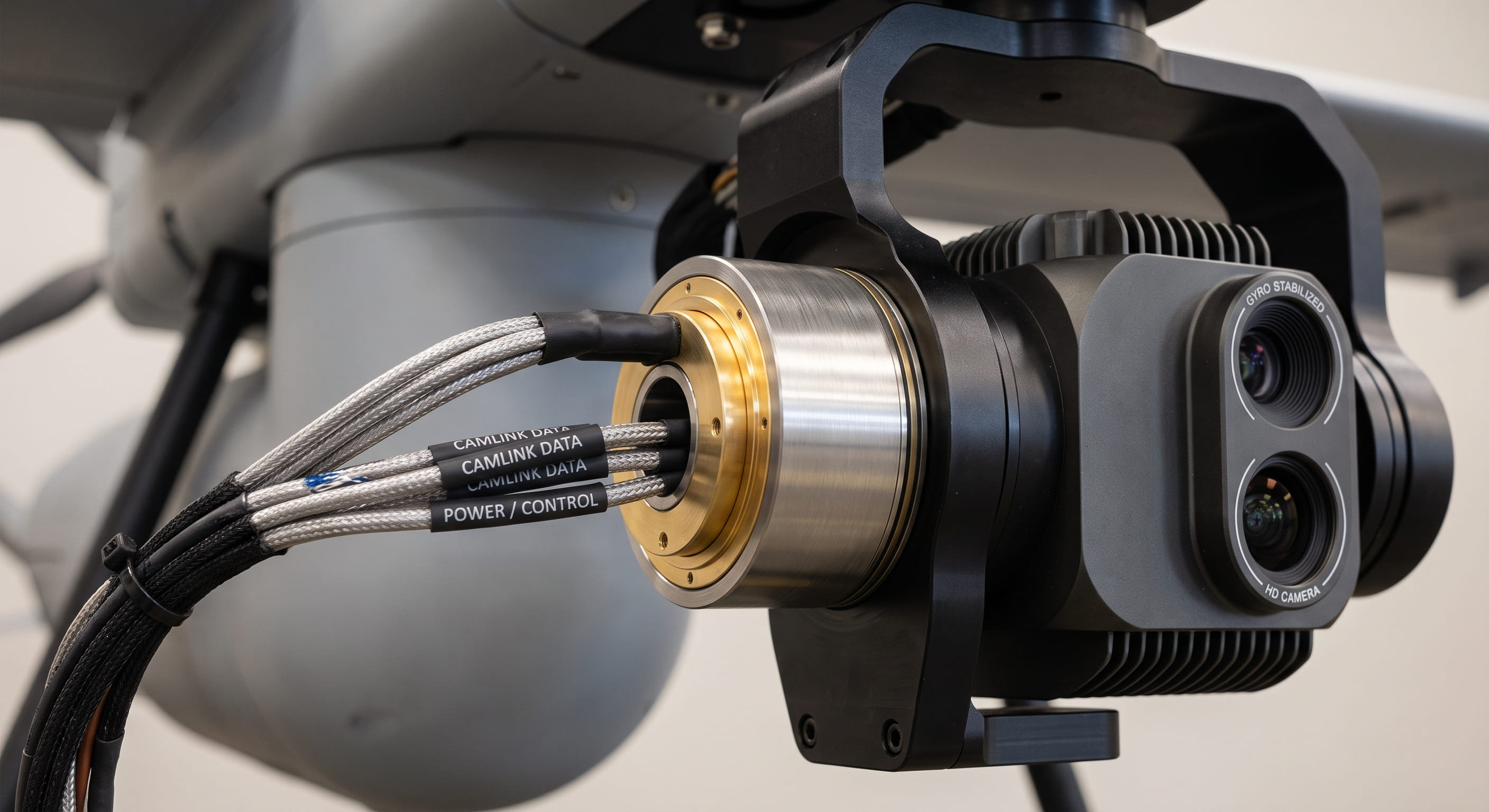
Inertial Navigation Systems (INS) are widely used to determine position, velocity, and orientation without dependence on external references such as GPS. These systems rely on highly sensitive gyroscopes and accelerometers, which are often mounted on rotating platforms such as gimbals, stabilized payloads, radar units, and electro-optical systems. In such configurations, maintaining reliable power and data transmission between rotating and stationary parts is a critical engineering which requires inertial navigation slip rings.
A slip ring is an electromechanical interface that enables continuous electrical connection during unlimited rotational motion. In INS-based rotating platforms, slip rings are responsible for transmitting power, control signals, and high-speed sensor data without cable twisting or mechanical stress. Unlike conventional slip rings, inertial navigation slip rings must meet much stricter performance criteria due to the extreme sensitivity of inertial sensors and imaging systems.
Inertial navigation slip rings designed for Camera Link transmission must ensure exceptional signal integrity. Transmitting Camera Link (CAMLINK) signals requires highly controlled and low-noise transmission environment due to the protocol’s high data rates and parallel differential signaling structure. When CAMLINK signals transmitted across rotating interfaces, such as slip rings, the transmission path must be carefully designed with matched differential pairs, controlled impedance, and minimal contact resistance variation. Advanced transmission solutions often utilize precious-metal contacts or hybrid electrical and optical rotary joints to preserve signal integrity. Reliable CAMLINK signal transmission ensures stable, low-latency delivery of high-resolution image data, which is critical for machine vision, aerospace, and stabilized electro-optical systems. To support Camera Link communication, slip rings are engineered with controlled impedance signal paths, matched differential pairs, and minimal contact resistance variation.
The performance of an inertial navigation slip ring directly affects overall system accuracy and reliability. Even small signal disturbances introduced during rotation can degrade image quality, disrupt synchronization between inertial sensors and cameras.
Such slip ring solutions are commonly deployed in aerospace platforms, unmanned aerial vehicles, naval systems, military surveillance payloads, and stabilized electro-optical gimbals. In these applications, the combination of inertial navigation data and high-speed Camera Link video is essential for real-time situational awareness and precise control.